
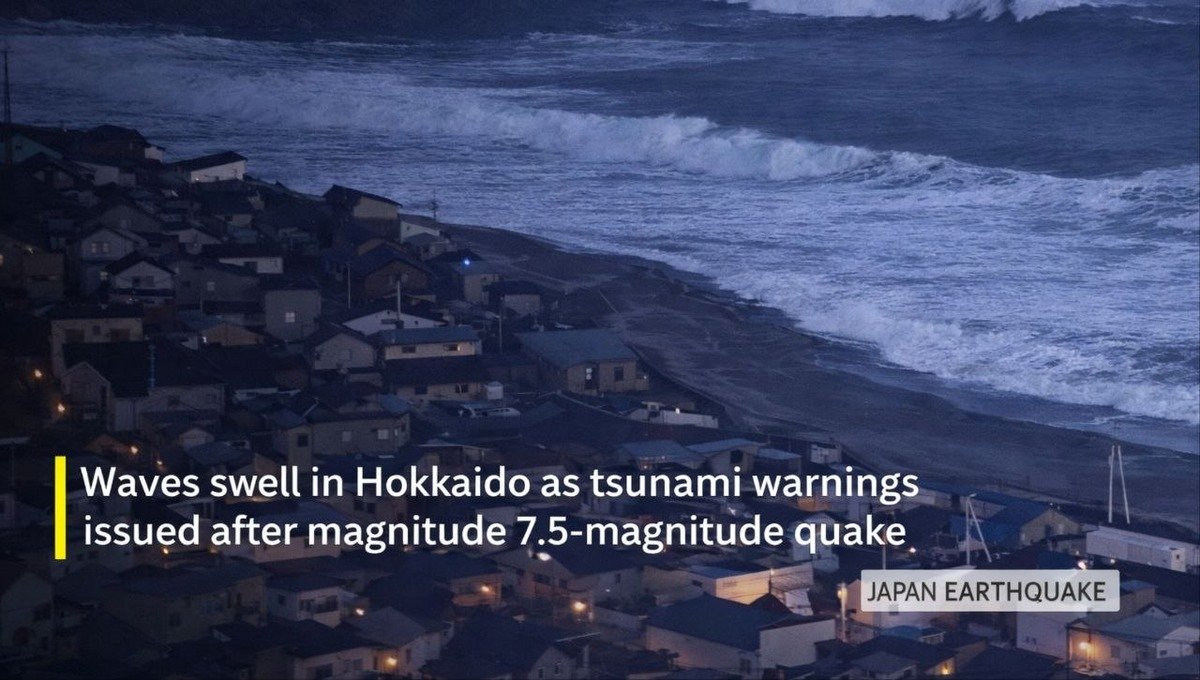
More than 170,000 people were ordered to evacuate across five Japanese prefectures Monday, April 20, 2026, after a devastating 7.7-magnitude earthquake struck off Japan’s northeastern coastline, forcing authorities to issue tsunami warnings of up to three meters for vulnerable coastal regions.
The Japan Meteorological Agency (JMA) initially recorded the seismic event before revising the magnitude upward from earlier estimates. The US Geological Survey had first registered the tremor at 7.4 magnitude, with tsunami alerts transmitted through the US Tsunami Warning System at 8:52 UTC, as reported by public broadcaster NHK and Kyodo News.
Widespread Tsunami Alerts Across Multiple Prefectures
Three-meter tsunami warnings were declared for Iwate Prefecture, Aomori Prefecture’s Pacific coastline, and the central Pacific coastal areas of Hokkaido. Additional advisories predicting waves reaching one meter were extended to Fukushima Prefecture, Miyagi Prefecture, Aomori’s Japan Sea coast, and both western and eastern sections of Hokkaido’s Pacific shoreline.
Coastal monitoring stations recorded tsunami waves as high as 80 centimeters at Kuji Port in Iwate Prefecture, representing the most significant wave heights documented during the event. Additional coastal locations within the warning zones measured waves of approximately two-and-a-half feet as the tsunami reached Japan’s Pacific shores.
Meteorological officials emphasized that even modest tsunami waves possess considerable destructive capability. Authorities stressed that waves measuring just one foot in height carry sufficient force to topple individuals and transport debris through urban areas, while receding waters can pull people toward the ocean.
Government Crisis Response Mobilized
Prime Minister Sanae Takaichi announced the activation of a government emergency task force to evaluate damage assessments. “Residents in areas where tsunami warnings have been issued should immediately evacuate to higher ground or safer locations such as evacuation buildings,” Takaichi declared to reporters during an emergency press conference.
Japan’s disaster management authorities verified that evacuation directives affected 171,957 individuals across the five impacted prefectures. This comprehensive evacuation operation constituted one of the most extensive emergency responses implemented since the catastrophic 2011 Tohoku earthquake and tsunami.
During a Monday evening briefing, Chief Cabinet Secretary Minoru Kihara reported that preliminary assessments had not documented injuries or residential property damage, though the situation continued evolving as authorities maintained their damage evaluation processes. Kihara noted that approximately 200 power failures had been reported throughout affected regions, with utility companies actively working to restore electrical service.
Transportation Infrastructure Severely Disrupted
Railway operations were extensively suspended following the earthquake as safety protocols were implemented. JR East reported that the Tohoku Shinkansen bullet train service connecting Tokyo and Shin-Aomori was discontinued due to power system failures. The suspension impacted thousands of passengers and generated substantial delays across the entire rail network.
The Yamagata Shinkansen route linking Tokyo to Fukushima was similarly suspended while authorities performed safety evaluations of tracks and supporting infrastructure. All regional train services throughout Iwate Prefecture were temporarily shut down, leaving numerous communities briefly isolated as officials determined railway operation safety standards.
Regional airport operations were also temporarily suspended, with aircraft redirected to alternative airports beyond tsunami warning zones. Pacific coast ferry services were halted pending official clearance notifications.
Nuclear Power Facilities Maintain Safety Standards
Tokyo Electric Power Company (TEPCO) confirmed that no irregularities were identified at the Fukushima Daiichi and Fukushima Daini nuclear facilities, although personnel were evacuated as precautionary measures. The company activated emergency procedures developed following the 2011 nuclear catastrophe at identical locations.
The Onagawa and Higashidori nuclear installations situated further north similarly reported standard operations, with radioactive material measurements remaining within established safety parameters. Facility operators verified that all safety mechanisms were operating correctly and cooling systems maintained functionality.
Nuclear oversight authorities deployed inspection teams to all regional facilities for thorough safety evaluations. The rapid response demonstrated knowledge gained from the 2011 Fukushima nuclear disaster, which resulted from earthquake and tsunami infrastructure damage.
Continued Seismic Activity Warnings
The Japan Meteorological Agency cautioned that comparable magnitude aftershocks could develop throughout the following week and advised coastal area residents to maintain alertness. Seismologists highlighted that the primary earthquake represented substantial tectonic stress release, though additional tremors remained probable.
Historical records indicate that significant earthquakes in this geographic region frequently generate substantial aftershocks capable of inflicting further damage to structures already compromised by initial events. Officials recommended that residents maintain emergency provisions in accessible locations and stay prepared for potential additional evacuations.
Emergency accommodation facilities remained operational across affected prefectures, with municipal governments coordinating food distribution, water supplies, and temporary housing for displaced residents. Social services were deployed to support elderly and disabled individuals requiring enhanced assistance during evacuation procedures.
Enhanced Disaster Preparedness Systems
Japan is positioned along the Pacific “Ring of Fire,” among Earth’s most seismically active geological zones, experiencing regular tremors annually. The nation substantially reinforced earthquake warning infrastructure and evacuation protocols after the 9.0-magnitude Tohoku earthquake and tsunami of March 2011, which caused meltdowns at Fukushima Daiichi nuclear facilities.
The 2011 catastrophe claimed nearly 20,000 lives and generated widespread devastation throughout northeastern Japan. Subsequently, Japan allocated significant resources toward early warning technologies, tsunami protection barriers, and evacuation infrastructure designed to reduce casualties from future seismic incidents.
This recent earthquake evaluated these improved preparedness systems, with preliminary reports indicating that enhanced warning mechanisms and evacuation procedures contributed to minimizing casualties and structural damage.
Communities along the coast that endured the devastating 2011 tsunami were included among those directed to evacuate, with many residents rapidly relocating to designated evacuation facilities and elevated terrain based on their prior disaster experience.
Photo credit: Photo courtesy of Japan Meteorological Agency
Related stories